
System leadership: Building change ready teams
How to create traction and results that stick with a proper model for learning about change
Most organisations invest heavily in leadership development. Some invest in transformation programmes too. Very few connect the two - invest in leaders will pay dividends in transforming your organisation. But it needs to be the right sort of investment. In this article I explore the leadership skills framework which underpins successful change.
HR teams design well-structured leadership and change interventions. Transformation teams build detailed delivery plans. Finance signs off significant investment.And at the top, strategy is usually clear. And still, something doesn’t move. The strategy is understood but behaviour doesn’t shift. The decision-making is sound but execution stalls. The change programme is well designed but adoption fades.
From the outside, it looks like a capability problem. It’s far more than that, it’s a systems problem. Because what most organisations call “leadership capability” is actually a collection of separate skills being applied in isolation. And when you treat a connected system as a set of independent parts, you don’t improve performance. You create friction. More activity, more intervention, less actual movement
Leadership skills are useless in isolation
The mistake most organisations make is not what they focus on. It’s how they structure it. Leadership is broken down into separate skills, each treated as an independent lever. Each one becomes its own training course, its own framework, its own improvement plan. On paper, this feels rigorous. In practice, it creates fragmentation. Because leadership does not operate as a set of isolated capabilities. It operates as a connected system, where each part changes the behaviour of the others. Improve one in isolation, and you don’t strengthen the system. You distort it. You end up optimising parts of leadership that were never designed to work separately in the first place.
The six skills most organisations turn into a checklist
The capabilities themselves are not the issue. Most organisations already know what “good” looks like:
Systems Thinking - seeing the whole, not just your part
Direction & Connection - creating meaning people move towards
Stakeholder Leadership - working with the real network, not the org chart
Decision Making - navigating complexity with judgment
People & Change Adoption - understanding the human response to change
Delivery - executing in a way that produces learning, not just output
The problem is how these are used. They get separated into modules. Decision-making training over here. Change management programme over there. Leadership presence somewhere else. Each one improved in isolation. But leadership doesn’t happen in isolation. It happens in the messy, interconnected reality where all of these are operating at once, influencing each other, reinforcing each other, or quietly undermining each other.
Systems thinking has told us this before - this is not new
Peter Senge made a simple point in The Fifth Discipline: you cannot improve part of a system by treating it as if it stands alone. His metaphor was blunt. Split an elephant in two and you don’t get two manageable elephants. You get a dead one. Most organisations are still trying to improve leadership by splitting the elephant. What gets missed is the most important part of the system: people. Not as something to manage once the real work is done. But as active participants who shape outcomes from the beginning. Once you see that, leadership stops being a sequence of steps and starts to look like a system you are part of.
What is new? How the six capabilities actually connect
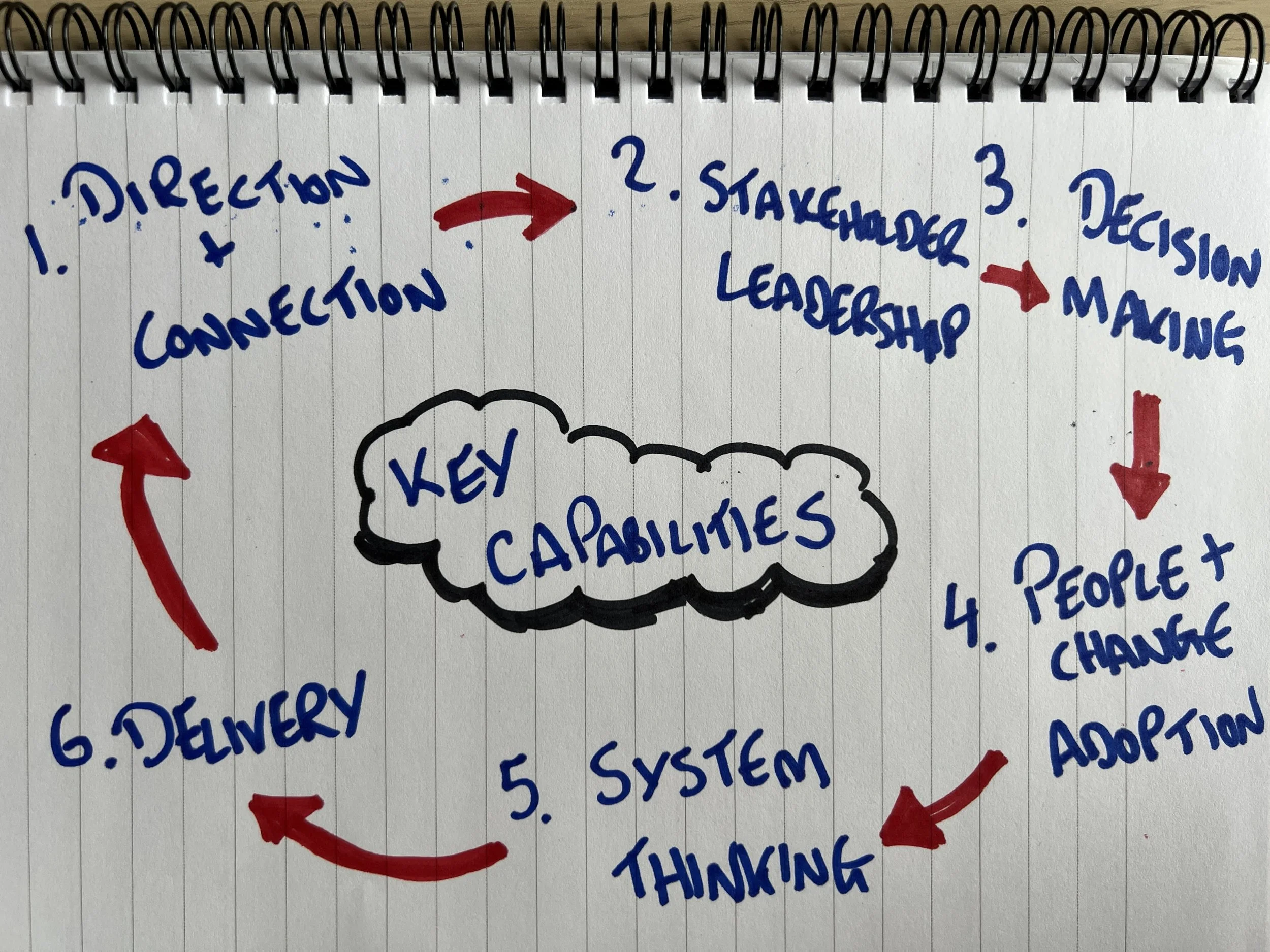
Start here. These are not six separate capabilities. They are one system. If one is weak, the others compensate, distort, or fail.
Systems Thinking is where it begins. This is your ability to see what is actually happening, not what the reporting says is happening. The patterns. The feedback loops. The unintended consequences of last year’s “good decision”. Without it, you don’t just solve the wrong problem. You make the real problem harder to see.
Direction & Connection comes next. Direction on its own is cheap. Most organisations are not short of strategy decks. What matters is connection. If people cannot see themselves in the direction, they will comply at best and quietly resist at worst. You are not installing a vision. You are finding the intersection between what the organisation needs and what people already care about. Miss that, and your “clear direction” becomes background noise.
Stakeholder Leadership is where this gets real. The org chart is not the system. The network is. Every stakeholder carries context, influence, and informal power. Ignore that, and decisions that looked solid in the boardroom unravel in the real world. Engage it properly, and the quality of thinking improves before you even make the call. This is not alignment. It is intelligence gathering in plain sight.
Decision Making is the moment of commitment. This is where most leaders believe they are at their strongest. In reality, this is where weaknesses upstream show up. If your system read was partial, you decide on the wrong thing. If your stakeholders were not genuinely engaged, the decision lands without traction. If there is no real connection to direction, people execute mechanically and miss the point. The decision is not the hard part. Creating the conditions for a decision to work is.
People & Change Adoption is where most organisations get it wrong. They treat it as something that happens after the decision. It doesn’t. People start forming their response the moment they sense change coming. Before the announcement. Before the slide deck. Often before you think anything has started. If you are not working with that from the beginning, you are not leading change. You are reacting to it.
Delivery is where reality shows up. Not as success or failure, but as signal. Most teams treat delivery as execution against a plan. Hit the milestones. Report progress. Move on. That misses the point. Delivery tells you what the system is actually doing. The gap between what you expected and what is happening is the most useful information you have. Ignore it, and you repeat the same mistakes faster. Use it, and you create a system that learns.
The shift most leaders miss
The conventional model is simple: leaders decide, communicate, and then manage how people respond. People become the last mile problem. The systemic model is different. People are part of the process from the beginning. They shape what is possible, surface what is real, and determine whether anything actually changes. This is not a philosophical point. It is practical. When people are treated as agents rather than recipients, organisations move faster, encounter less friction, and produce results that stick. Leaders who work this way don’t just behave differently. They see differently. They ask better questions. They build trust deliberately because they understand its impact on performance.
What this means in practice
If you’re a senior leader, the question isn’t which of these capabilities you need to improve. It’s whether you’re operating them as a system or as a checklist. A few questions worth mulling over:
Where are you making decisions before properly engaging the human system?
Is change adoption built in from the start, or added at the end?
Are people contributing to direction, or receiving it?
When delivery produces surprises, do you treat that as failure or as signal?
Because the difference shows up quickly.
Checklist leadership creates activity, friction, and slow decay.
System leadership creates traction, learning, and results that hold.
Most organisations don’t fail because they lack capability. They fail because they misapply it.
If you’re responsible for transformation and this feels uncomfortably familiar, it’s worth taking a proper look at how your system is actually working. That’s a very different conversation from “which skill do we train next”.