
Change is no longer a specialist’s job
I opened a talk recently with a question that tends to make a room go quiet: does it actually matter if your people don't feel the need to change right now?
My answer is that it matters more than almost anything else right now, because the world has stopped waiting for organisations to feel ready. We say it so often it's become wallpaper: change is the new normal, the pace of change is faster than ever.
But it's worth pausing on why that's true, because once you see the reasons clearly, the conclusion is hard to avoid. There are three key reasons and when you look at them together, the feelings makes sense.
1.The cycles of disruption are shrinking
Go back roughly 250 years to the first industrial revolution, steam, mechanised textiles, the move from workshop to factory. That single shift triggered something like 120 years of disruption and change.
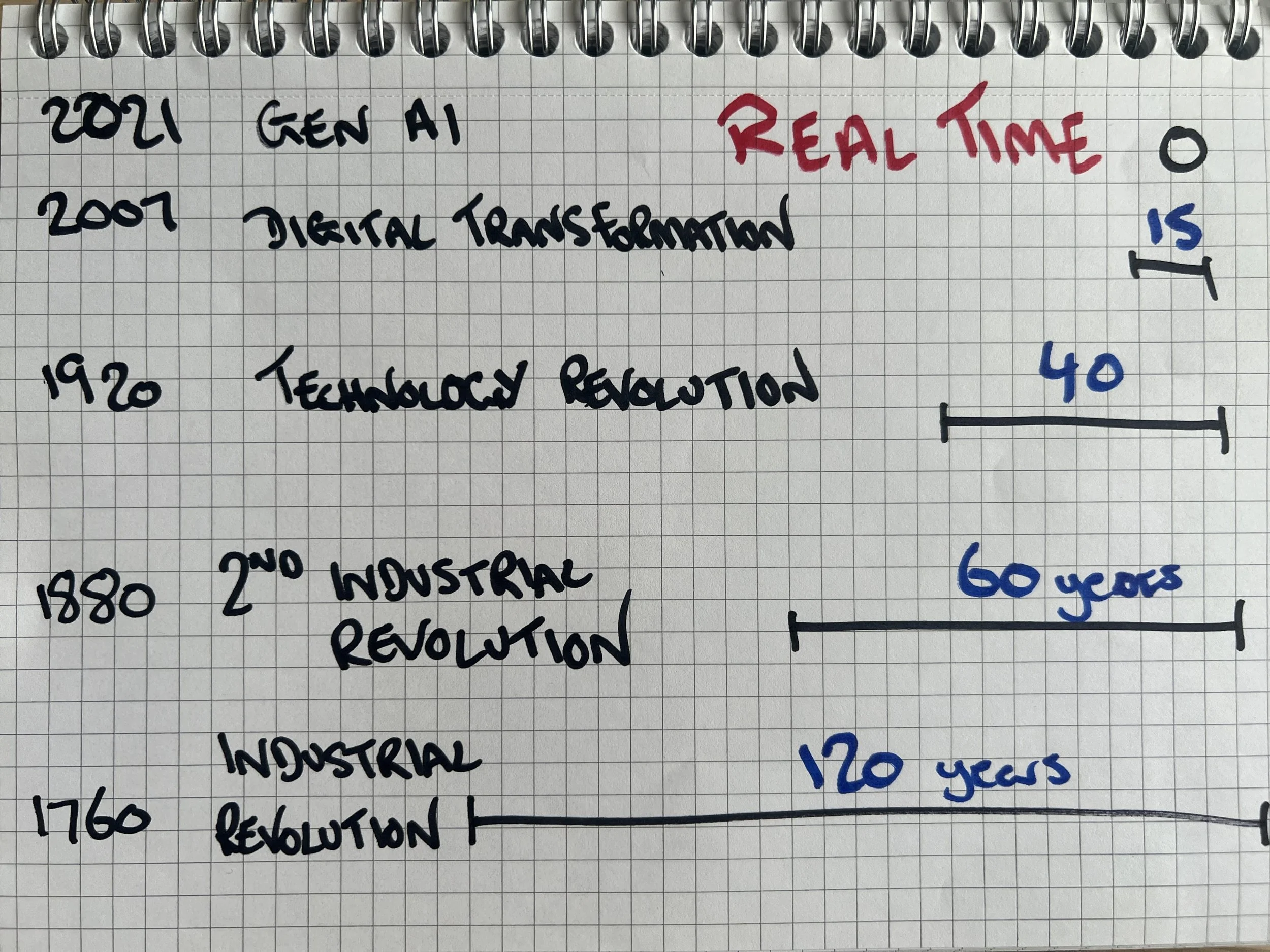
The cycles of change are decreasing - what once took generations now takes a few weeks
Then, around 1870, the second industrial revolution arrived: electricity, steel, the railways, the telegraph. Roughly 60 years of change.
After that came the technology revolution, chemicals, engines, the machinery of the mid-twentieth century. Call it 40 years.
Eventually the internet and the smartphone gave us around 15 years of digital transformation.
And now AI is reshaping entire industries in real time.
I'd treat those spans as illustration rather than precise history, but the direction is unmistakable. What once took generations, now takes a few years. The cadence is collapsing , and any organisation built for stability is quietly struggling to cope with what has become permanent, constant change.
2. Customer expectations are at an all-time high
A client of mine used to say something I've never forgotten: the last best experience your customer had becomes their expectation of normal. Sit with that for a second. The expectation of normal. If I can return something instantly in one shop, I expect it everywhere. If I can open a bank account on my phone with one bank in three minutes, I expect that from all of them. Your customers are no longer comparing you to your competitors, they're comparing you to the best experience they've had anywhere and that puts relentless pressure on you to keep up.
3.The way we deliver change has itself changed
When I started out thirty years ago, change had a shape. Analysts drew process maps. Business analysts wrote requirements. Then came testing, handovers, release cycles. Standing up a new system could take years. I was reminded how far that's moved while working with an online mortgage broker. I'd done a six-week diagnostic with them, and at the point in any normal project where you'd start training people on the recommendations, I asked when they wanted to begin.
"Begin what?" they said. "Paul, we've already implemented it. All of it."
I must have looked baffled, because they explained: half the company are software engineers.
If they decide to do something today, it's live in the system tomorrow.
That was the moment it really landed for me, not just that change is faster, but that the gap between deciding and doing has almost vanished.
So what does this actually mean for teams?
Put the three things together and the picture is clear; the world is changing faster than our organisations were ever designed to handle. We need to rethink how organisations are 'set up to deliver change. Change is no longer an occasional project with a start date and an end date. It's continuous.
And here's the part most organisations haven't caught up with. If change is constant, then the ability to change can't live in a specialist function. It can't sit with the transformation team, or the programme office, or whichever group happens to have "change" in its job title.
Adaptability has become a survival skill, and survival skills belong to everyone. Not a department. Not a chosen few. Part of how the whole organisation thinks and works. Part of its DNA.
That's a genuinely different way of building an organisation, and in my experience it's the thing that separates the businesses that thrive on disruption from the ones that merely survive it. The work isn't to run more change programmes. It's to build the capability to change into the organisation itself so it doesn't have to be rented in every time the ground shifts.
And yet, when organisations finally act, they buy certification
Here's where it gets interesting. Most HR Directors and transformation leaders understand this problem intuitively. When I describe it in keynotes, people nod. They feel it. They know their organisation is struggling to keep up. But when they go looking for a solution, the market hands them the wrong answer. Search for help building change capability in your organisation and you'll find certification. Prosci. APMG. Change practitioner qualifications. Courses that take a handful of individuals and teach them a methodology. A certified individual is not a change-capable organisation.
Think about what certification actually does. It concentrates knowledge in a small group of specialists, the very people who already have "change" in their job title. Everyone else carries on as before. The next initiative still meets resistance. Managers still struggle to bring their teams with them. Adoption still fades after go-live. Certification solves the wrong problem. It answers the question "who should we qualify?" when the real question is:
"what does everyone in this organisation need to know, do and believe differently so that change lands, sticks and doesn't exhaust people every time?"
That's a capability question. And the market barely touches it.
Building change capability across a workforce isn't about creating more specialists. It's about making adaptability part of how the whole organisation thinks and works, distributed across managers, teams and functions, not concentrated in a programme office. That's a genuinely different kind of investment. And it's the one most organisations haven't made yet.
I write about building that kind of internal capability every week in The Change Brief. If it's on your mind, that's where the conversation continues.