
All great change is preceded by CHAOS™
I've spent years working in business transformation, and if there's one thing I've learned, it's this:
All great change is preceded by CHAOS™.
Not managed away. Not avoided. Or Harnessed. Transformation isn't about controlling every detail, it's about taking the disruption that's already happening and giving it somewhere useful to go.
That's what CHAOS is: Compelling Vision, Heart, Action, Open Communication, Supply.
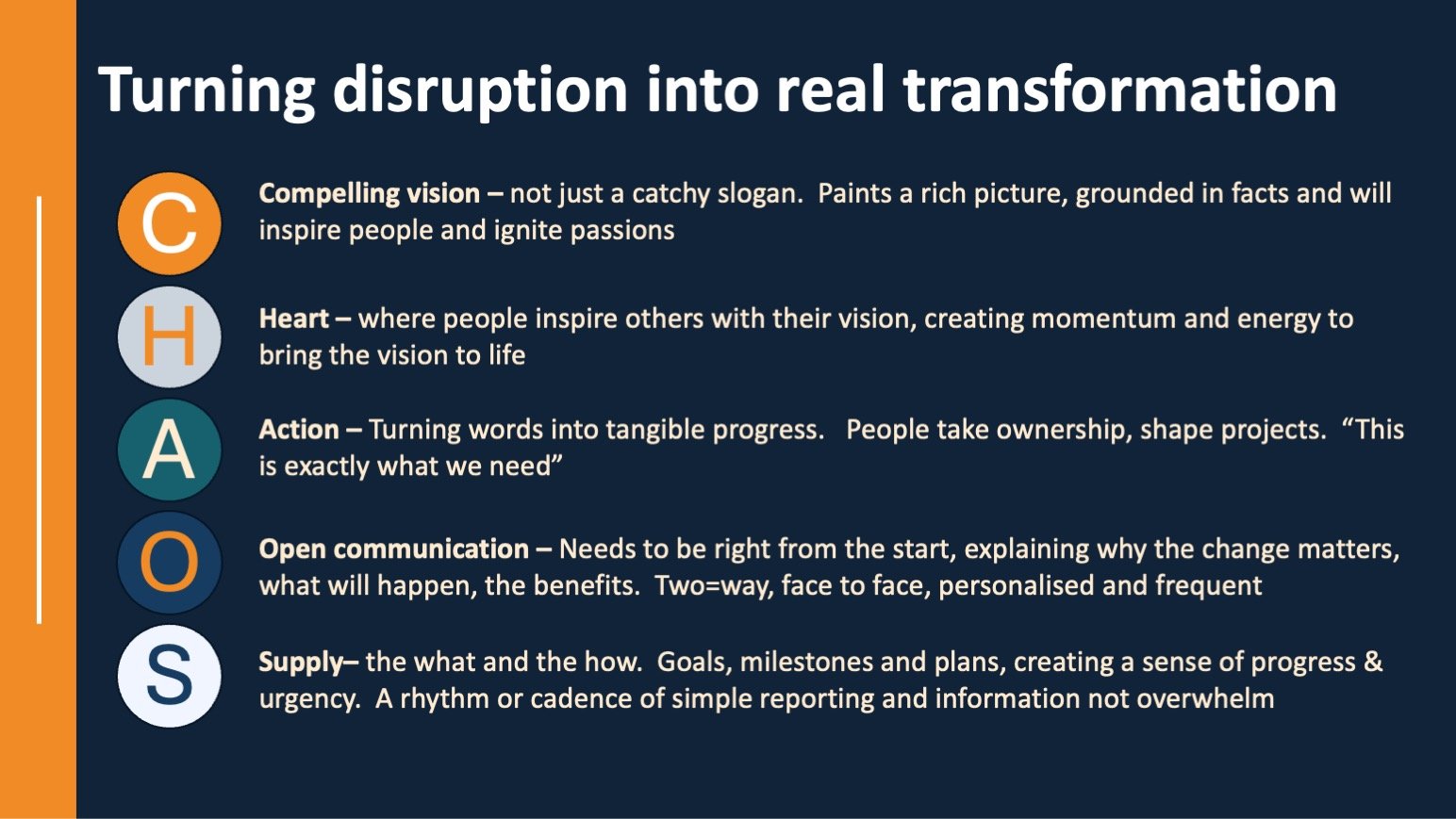
The CHAOS™ methodology
Five things that have to be true at the same time for a transformation to actually land, not five stages you tick off in order.I didn't invent it in a workshop. I built it from watching the same failure pattern repeat: a good idea, a solid plan, real investment and still nothing moves. Once you've seen that enough times, you stop asking "what went wrong" and start asking "which of these five was missing." It's almost always at least one.
C: A Compelling vision
Every transformation starts with a clear, compelling vision of the future, one that excites and motivates people, not just describes a destination. Without it, efforts stall before they begin.
A compelling vision isn't an abstract goal. It's a vivid, inspiring picture of what success actually looks like, ambitious enough to matter, achievable enough to believe. Done properly, it does four things at once: creates alignment, so everyone's pulling toward the same outcome; ignites passion, so people commit energy and creativity rather than just compliance; guides decision-making, acting as a north star when things get uncertain; and drives urgency, making clear why this matters now rather than eventually.
None of that comes from a slogan. It comes from storytelling and real examples that make people feel the need for change, not just understand it intellectually.
H: Heart, bringing the vision to life
Vision alone isn't enough. Transformation is fuelled by people, and Heart is where brave leaders step up to bring it to life.
That means visionary leadership that creates real urgency and momentum, not just announces it. It means focusing energy on the people who will actually carry the transformation; they're the lifebood of the change, not a delivery risk to be managed. It means active listening: adapting the vision by having real conversations, and, this is the part leaders find hardest, genuinely asking for help rather than only offering direction. And it means holding high standards with a human approach: relentless about the goal, never at the expense of the people getting you there.
Heart is the most uncomfortable letter for a lot of leaders, because it asks for something a status update never does. It's also the one people can always tell when you're faking.
A: Action — turning words into progress
Transformation happens when ideas move from talk to action. This is where employees stop receiving the change and start owning it.
Done well, teams contribute by developing and refining the vision themselves. Employees actively give feedback on what needs to change, not just on how it's landing. Individuals start shaping the actual projects, initiatives, and solutions. When that shift happens, transformation stops being a leadership initiative that's being rolled out to people, and becomes a collective movement that people are inside of.
O: Open communication — the lifeline of change
Communication isn't a sideshow running alongside transformation. It's the artery it flows through.
It has to start strong, from day one; vision, outcomes, and benefits communicated before people are left to fill the gap themselves. It has to be genuinely two-way: listening, adapting, involving people in shaping the message, not just receiving it. It has to go beyond email, face-to-face conversations, workshops, whatever channel actually reaches the person you're trying to reach. It has to be personalised and passionate, showing people why you care, so they have a reason to. And it has to be frequent and regular, keeping pace with the heartbeat of the change rather than a quarterly update that arrives long after people have already decided what's going on for themselves.
S: Supply — the how and what of delivery
Once the vision is clear and the transformation has momentum, execution becomes the focus and this is where expert technical teams bring the transformation to life.
Supply is fundamentally about capability: having people who know how to actually deliver, not just plan. What that expert delivery looks like in practice is getting the balance right. Plans, not paralysis, no hundred-page roadmaps, just actionable steps. Clear goals, objectives, and milestones as stepping stones. A steady rhythm of updates and communication that drives cadence. Simple reporting, enough to stay informed without burying anyone. And a sustained sense of urgency and momentum that keeps teams moving rather than coasting.
Rhythm and reporting aren't the definition of Supply. They're what expert delivery teams use to make sure the capability they bring actually lands.
The art of sustainable transformation
Transformation isn't about checking boxes. It's about continuous improvement and change that holds after the programme team has moved on. The best leaders don't just implement change, they teach, guide, and empower others to sustain it long after the initial push is over.
Which is really the point of naming this model CHAOS in the first place. Chaos isn't the enemy of transformation. It's the birthplace of it. Embrace it, lead through it, and use it to build something better, that's the whole job.
If you want to know which of the five letters is actually weak in your organisation right now, that's precisely what a Change Compass session gives you: clarity in days, not months of guessing.
Paul Cook is The Transformation Guide. If you want to find out which letter of CHAOS is missing in your transformation, book a Change Compass or get in touch.