
Building internal capability to transform a business
Business context
Our client had recently brought together two teams with different structures, ways of working and cultures. At the same time, the organisation was investing heavily in AI, new technology and broader business transformation. A future operating model had already been designed, but the leadership team faced a familiar challenge:
How do you turn a well-designed operating model into reality
without becoming dependent on external consultants?
Rather than handing implementation to a programme manager or consultancy, the bank wanted its own leaders to take ownership of the transformation.
The challenge
The implementation required more than a project plan. The team needed to build the confidence, capability and routines to lead the programme themselves. They had experienced managers but none that had shaped or led an OpModel transformation., Many were looking for reassurance before making decisions and taking ownership.
There was a real risk that their lack of confidence in leading organisational change could undermine their belief in their future vision and their technical knowledge and experience.
Our approach
Having helped design the future operating model, Paul was asked to develop the implementation roadmap and support the team as they put it into practice. Instead of leading the programme himself, Paul designed an approach that developed the organisation's own capability to deliver it.
The programme began with a mobilisation workshop where the implementation team clarified the future operating model, agreed individual responsibilities and identified the work required to make the vision a reality. Together, the group established governance, planned the first steering group and agreed how progress would be monitored.
Over the following six months, each implementation lead received regular one-to-one coaching alongside the wider programme. These sessions were deliberately confidential. They gave people the opportunity to discuss challenges, test ideas and develop their confidence before leading conversations with colleagues and stakeholders. Importantly, the coaching never removed their ownership.
Rather than solving problems on behalf of the team, Paul challenged individuals to define the issue, explore their options and decide what they would do next. Where gaps emerged, the team identified who would take ownership and incorporated the work into the programme plan.
The message throughout was simple:
No one else was going to deliver the transformation for them.
As leaders, they owned the change.
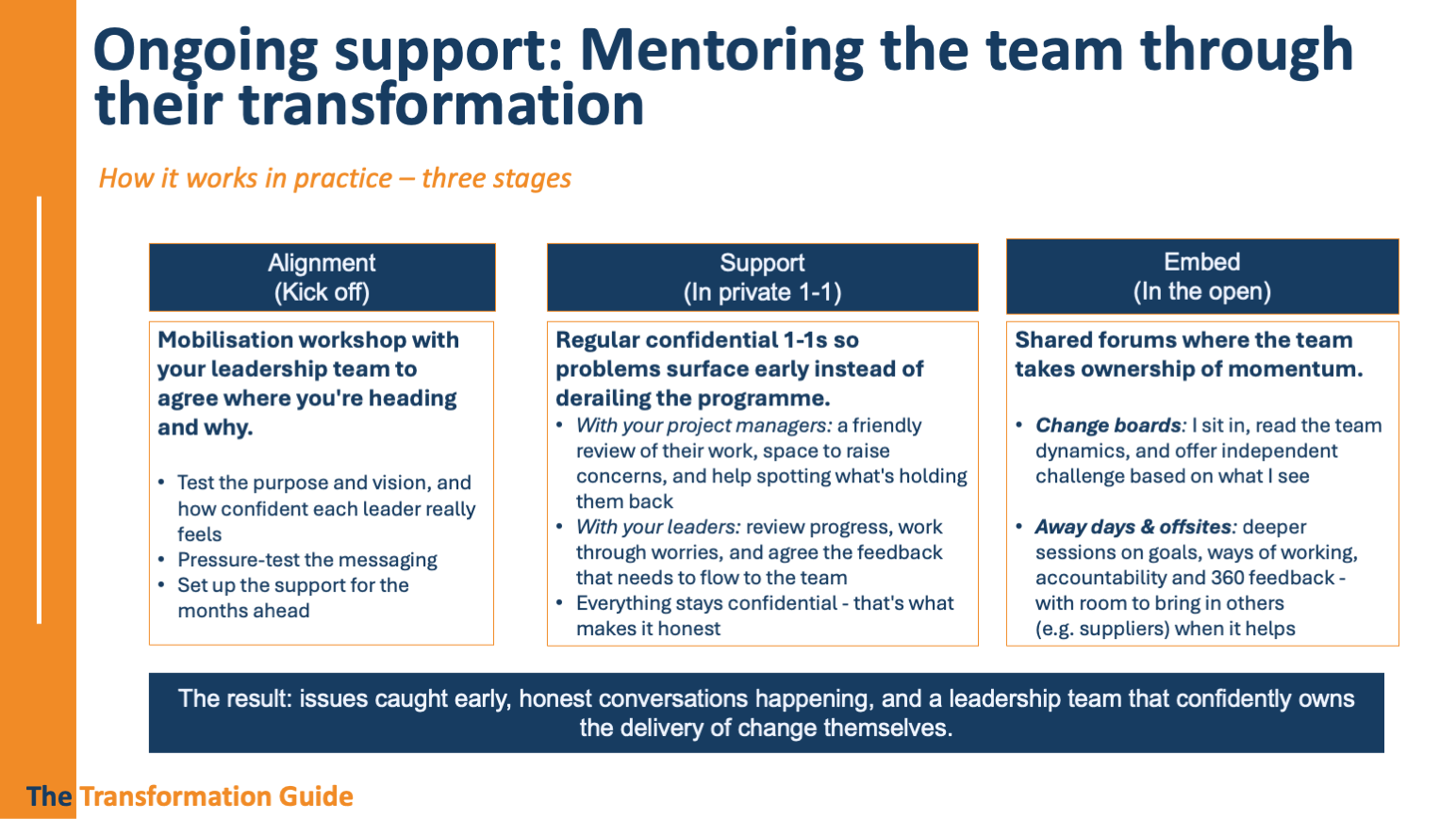
Our approach - on a page
The Turning Point
Around four months into the programme, the dynamic began to change. Conversations shifted from seeking permission to discussing options. People stopped asking what they should do and started explaining how they intended to tackle challenges. The steering groups became more effective, implementation plans matured and the team developed a consistent rhythm for managing delivery. By the end of the programme, the operating model was no longer being driven by an external adviser. It was being led by the organisation's own people. And Paul could step away and leave the team mobilised and energised.
Outcomes
Within six months, the team had:
Established taken ownership of the implementation roadmap themselves.
Built a confident team capable of leading the transformation themselves.
Created an effective governance structure with regular steering groups and clear accountability.
Delivered early improvements by prioritising quick wins alongside longer-term initiatives.
Developed a sustainable programme cadence, giving the organisation the momentum to continue independently.
Perhaps the biggest outcome was cultural rather than procedural. The implementation team stopped behaving like contributors to someone else's programme and started acting as owners of the organisation's future.
Key benefits
Many transformation programmes fail because consultants become responsible for delivery while internal leaders remain observers. This programme took a different approach. By combining a practical implementation roadmap with mentoring, the client team developed the confidence and capability to lead its own transformation.
As Paul Cook explains:
"My role wasn't to solve their problems for them. It was to help them become the people who could. Success wasn't measured by how much I delivered, but by whether they could continue without me.’
The client lead said:
"We didn’t know where to start. We were half ready but everyone was looking for reasons to put it off. Paul helped us ‘bite the bullet’ He has a relaxed but challenging style and my team responded really well. I know there were some nerves but once people started to air their thoughts, and discuss options, it was so refreshing to lead this ourselves. “
To mobilise a programme team of consultant to support this work for 6 months would typically cost north of £1m. This work cost less than 10% of that. The client team:
owned the solution from the start,
the solutions they designed resonated with the team and this increased buy-in and engagement
they build capability internally, that remains int he building and,
proved they could lead change succesfully